Ch 1–4
Foundations
What an LLM actually is (and why "AI" is the wrong word), supervision as the skill you already have, and classifying your data before it goes anywhere near an AI tool.
A plain language reference guide for academics
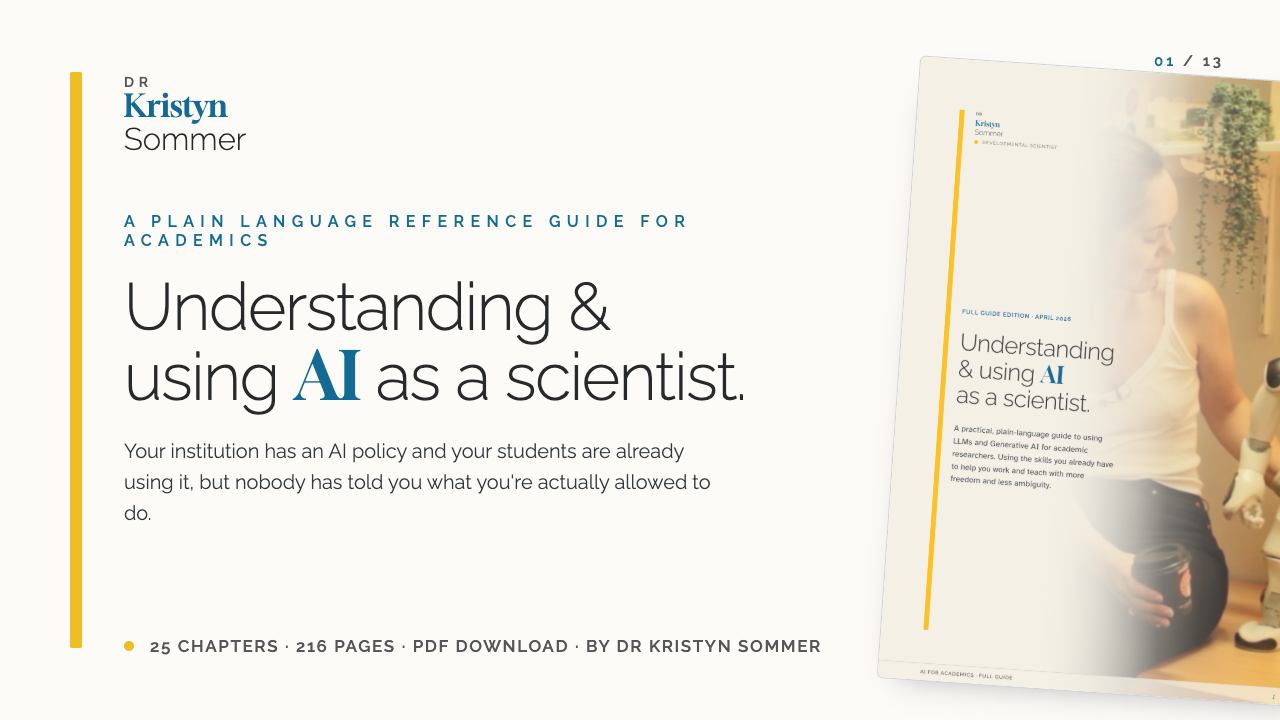
Your institution has an AI policy and your students are already using it, but nobody has told you what you're actually allowed to do.
Instant download. Not useful? Email me within 5 days for a refund. The preview is free and needs no email address.
The problem
First in 2020, when the pandemic forced every academic to rebuild teaching and research from a kitchen table. Then in late 2022, when ChatGPT landed and it suddenly felt like our students had the answer sheet to every assessment we'd spent a decade perfecting.
Now there's a policy, a framework, and a training module, and still nobody has answered the questions you actually have. Can my research data go in this thing? Do I have to disclose it? What do I do about the obviously-AI student email? Why is everyone else getting useful output while mine reads like customer service?
We are not behind because we are not capable. We are behind because the rules of our jobs keep changing and no one has taken the time to catch us up.
What this is
Understanding & Using AI as a Scientist is a 25-chapter plain language reference guide for academics working out where AI fits in their research and teaching, or who just need enough knowledge to guide their students. It assumes no technical background. It covers what these tools actually are, how to decide what data can safely go near them, a four-check loop for verifying what comes back, disclosure templates for manuscripts and grants, and how to handle AI in your teaching, your peer review, your ethics application, and your students' work. It shows you how to make AI output sound like you, instead of the garbled nonsense you're used to.
It's for the scientist who feels left behind by the AI revolution, or who's been deeply dissatisfied by an LLM while everyone else sings its praises.
What's inside
Ch 1–4
What an LLM actually is (and why "AI" is the wrong word), supervision as the skill you already have, and classifying your data before it goes anywhere near an AI tool.
Ch 5–7
What actually goes wrong (hallucination, sycophancy, scope creep), the four-check loop for catching it, and what disclosure really requires when your name is on the work.
Ch 8
The full walkthrough: setting up Claude safely, training off, folder structure, teaching it your voice, connecting it to the literature, and three starter tasks where a bad answer costs you nothing.
Ch 9–13
Participants who never consented to this, the assumptions hidden in the model, open science documentation, writing the paper, and where copyright risk actually converts to yours.
Ch 14–16
Reviewing papers without breaching confidentiality, drafting decision letters as an editor, and the blunt chapter on why grant review is a hard no.
Ch 17–21
Taking admin off your plate, making the actual teaching better, designing assessment AI can't shortcut, teaching AI literacy, and the essay on what to do about the obviously-AI student email.
Ch 22–24
The conversation to have with your PhD students, getting AI use past your ethics board, and an honest accounting of what your queries actually burn.
Ch 25 + back matter
The prompting vocabulary (why it ignores half of what you ask), plus a full glossary and prompt tables for behavioural and social scientists.
What you take out of it
The four-check loopSource · Scope · Voice · Ownership. Every output, every time.
Green / amber / red data classificationWith a one-page decision tree, so the call is made before the file is opened.
The 11-point de-identification checklistIncluding the trip-wire most people miss.
Disclosure templatesFor manuscripts, grants, and theses, matched to venue.
The session logThe ten-field paper trail that satisfies the Australian Code and your future self.
A five-day fast-trackFor the reader who wants to give this a real shot this week.
What you get
How it's built
Every chapter has the same shape: an entry checklist, a by-the-end box, the content, and one gate question you should be able to answer before moving on.
The literature review that produced a real synthesis sits next to the one that fabricated citations. The analysis that caught a problem sits next to the one that smoothed a problem over. The success shows you what good looks like. The failure shows you what the same tool produces when supervision slips. You need both.
Who this is for
This guide is for you if
This guide will not
About the author
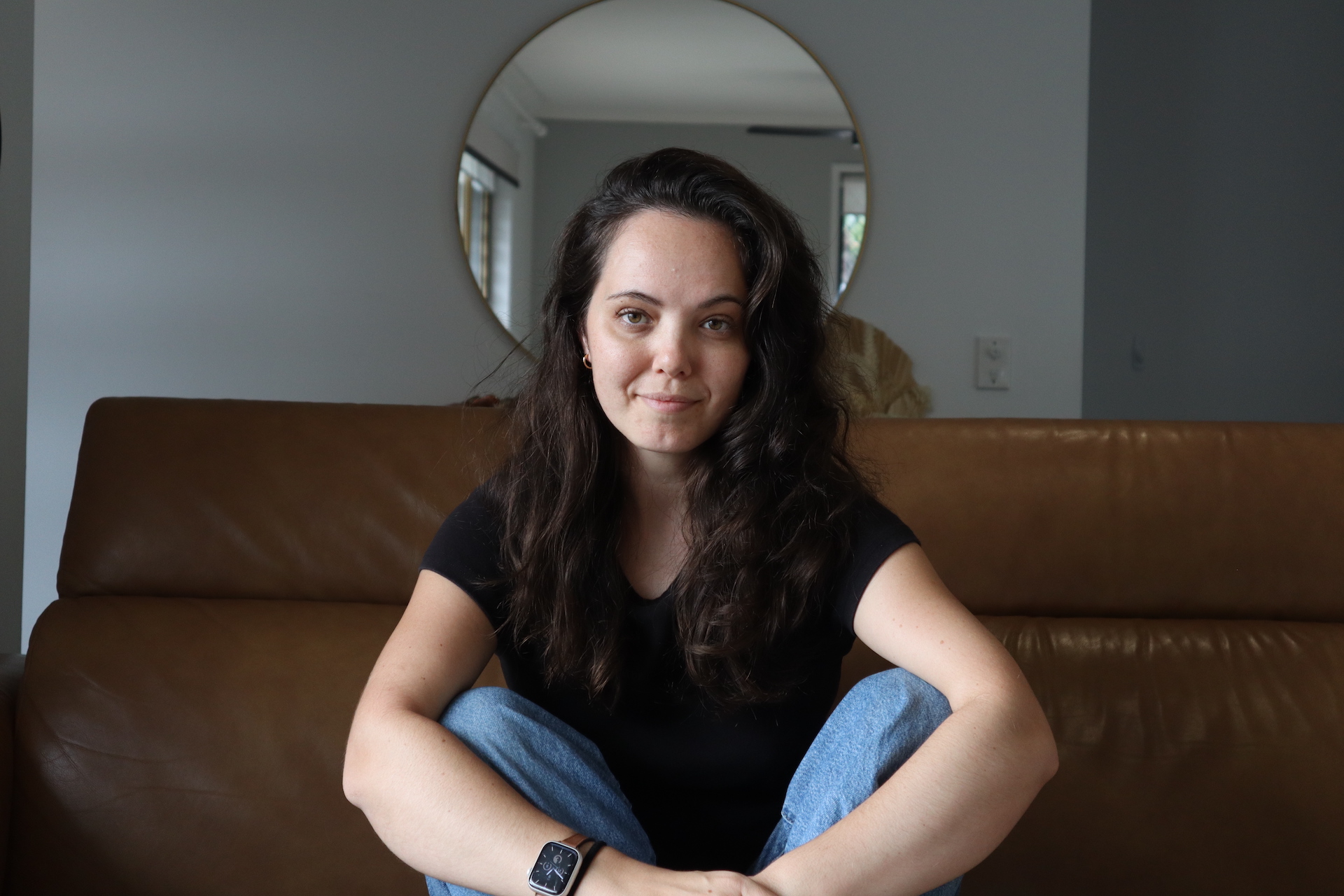
I'm Dr Kristyn Sommer, developmental scientist, autism advocate, and science communicator to a community of 500,000+. A year before writing this guide I walked back onto campus after two maternity leaves feeling completely lost. Even Copilot felt beyond my reach.
I caught myself up in a flurry of necessity and the kind of deep, intense focus that only an autistic special interest can produce, and then I wrote down everything I wished someone had told me, in the order I wished they'd told me.
The honest bits
I'm always updating what I know, and I'd rather hear that something is wrong than leave it sitting there being wrong. Feedback and constructive criticism are genuinely welcome, and most of what changes between versions comes from readers. There's a two-minute form for it, and updates are free once you've bought it.
Licence and limits
One reader. You. Print it, annotate it, keep it on every device you own, and quote it in a talk with attribution. All fine, and all intended.
What it doesn't cover is uploading it to a shared drive, a course site, or a repository, or passing the file on. If your department or lab wants it, that's good news and there's a team licence. Email me at hello@drkristynsommer.com.au and it costs less than buying it one at a time.
It isn't institutional policy, legal advice, ethics approval, or data-management advice. It doesn't replace your ethics committee, your data management plan, your research integrity office, or your institution's AI policy.
It reflects my own practice as at August 2026, and it's provided for education and professional development. Where it tells you to check something with your institution, that instruction is the advice. Check it.
Questions
The worked examples lean on my field (developmental psychology), but the frameworks (data classification, the four-check loop, disclosure, assessment design) are discipline-agnostic. If you have research data, students, and a name to protect, it applies.
No. The guide starts before the jargon does. There's a glossary for every term, defined once, in plain language.
Mostly, yes. One chapter (the setup walkthrough) is Claude-specific. The other 24 are about judgement, data, disclosure, teaching, and supervision. Platform-agnostic by design.
The tool screenshots will age; the practices won't. The guide explicitly refuses to track model releases. It teaches the habits that survive them.
Five files, delivered by email link immediately after purchase: the 196-page guide, a short Start here, the Working tools to print and keep next to you, the starter files to fill in, and a changelog. Read them on anything; print them if you're a print person. Designed for both.
Email me at hello@drkristynsommer.com.au for team licences.
It is, on a stipend. Email me at hello@drkristynsommer.com.au and ask, and I'll send you a code for 80% off. You don't have to prove anything or explain yourself. I'd rather you had it.
Email me within 5 days and I'll refund you. I'd rather have the feedback than the A$49.
The catch-up
The rules changed and nobody caught you up. This is the catch-up: 25 chapters, in plain language, from someone who was exactly where you are.
Instant PDF download. 5-day refund, just email me.